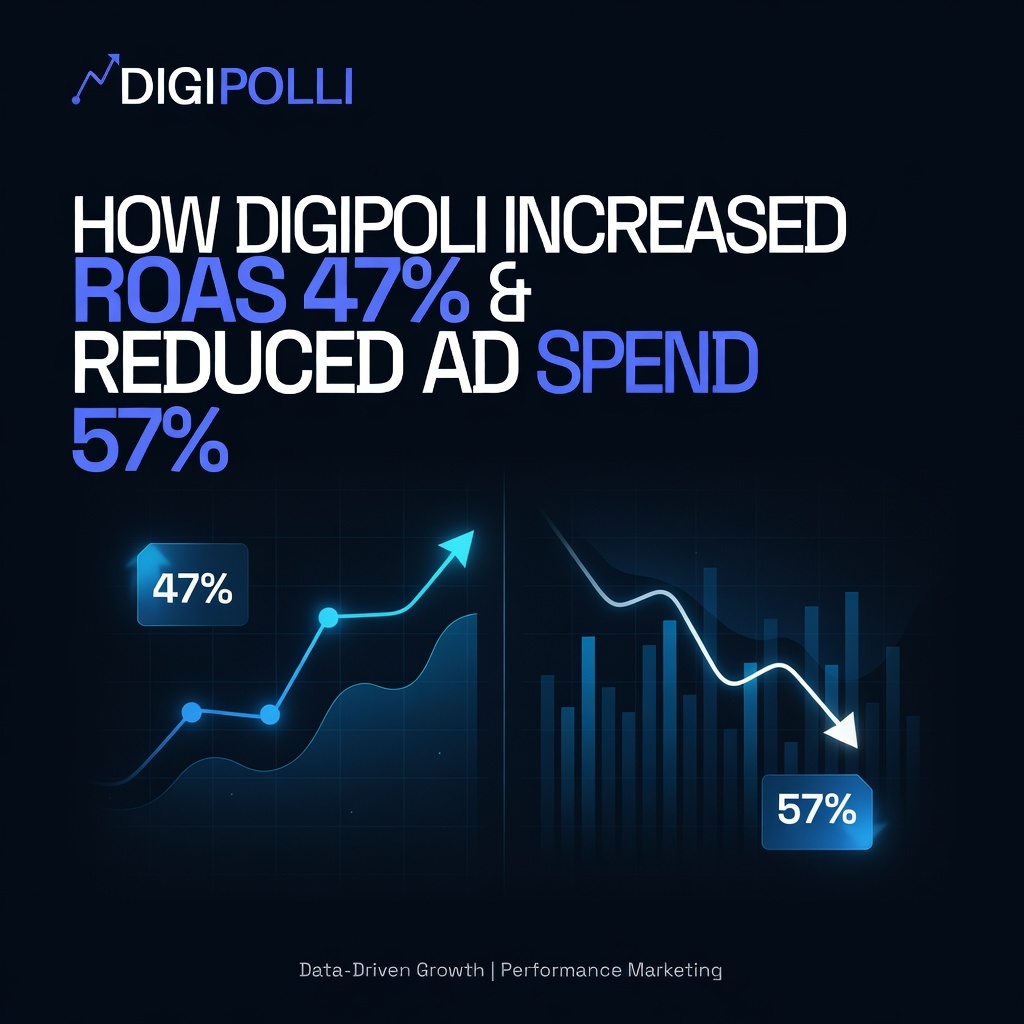
How DigiPoli Increased ROAS 47% & Reduced Ad Spend 57%
See how DigiPoli, a Google Ads agency in Bangladesh, increased ecommerce ROAS from 1711% to 2517% while reducing ad spend by 57%. Real data inside.
Performance Comparison
Before vs After Results
Sep 1–13
Sep 14–23
0%
Ad Spend Reduction
0.0%
Conversion Rate Increase
Results at a Glance
Key outcomes from this campaign
0%
Ad Spend Reduction
0.0%
Conversion Rate Increase
Client Overview
Every ecommerce brand running Google Ads faces the same fundamental question: how do you scale profitably without burning through your budget? For one Bangladeshi ecommerce brand, the answer came through a structured, data-driven optimization strategy executed by DigiPoli — a performance marketing agency in Bangladesh that specializes in Google Ads management.
The Challenge
Initial Performance Issues
This case study documents how we transformed an already-performing Google Ads campaign into a significantly more efficient revenue engine — increasing ROAS by over 47% while simultaneously cutting ad spend by more than 57%.
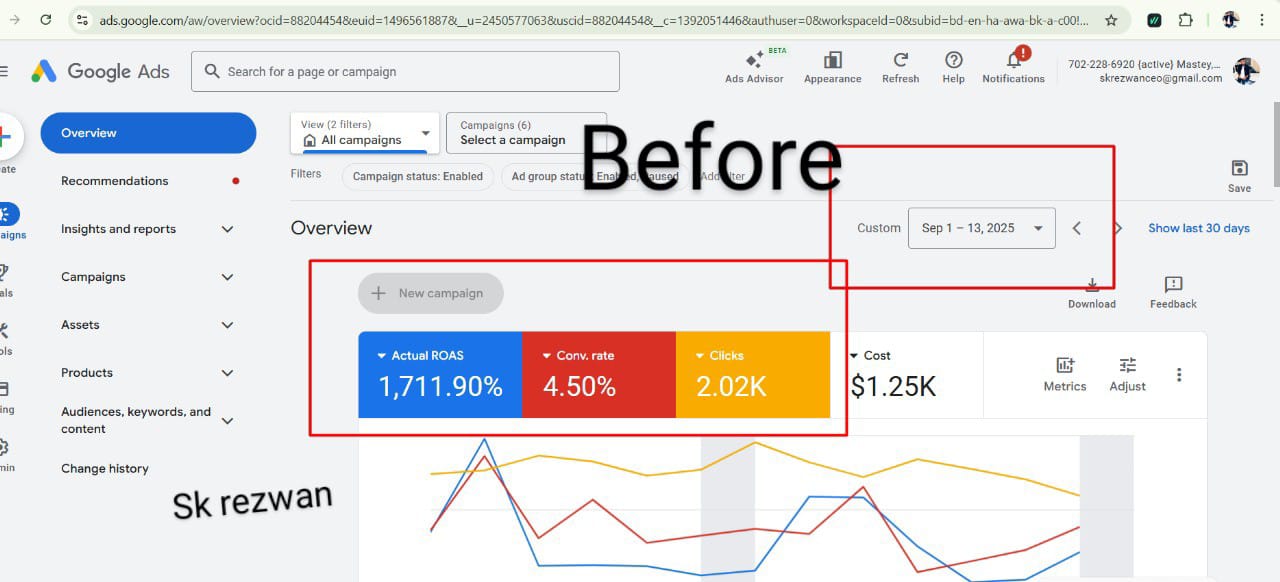
The client is a mid-sized ecommerce brand operating in Bangladesh's competitive online retail space. They were already running Google Ads campaigns with respectable results — a 1,711.90% ROAS and 4.50% conversion rate. However, they were spending $1,250 over a 13-day period with 2,020 clicks, and the cost efficiency wasn't where it needed to be for sustainable scaling. The brand approached DigiPoli seeking a Google Ads agency in Bangladesh that could optimize their existing campaigns for better returns without simply increasing budget.
Our Strategy
The Step-by-Step Growth Framework
Research & Analysis
Deep-dive into market data, competitor positioning, and audience behavior to identify growth opportunities.
Funnel Architecture
Design a conversion-optimized funnel from awareness to purchase with proper tracking at every stage.
Creative & Audience Testing
Systematic A/B testing of ad creatives, copy variations, and audience segments to find winning combinations.
Budget Optimization
Strategic budget allocation based on performance data — scaling winners and cutting underperformers.
Scaling Strategy
Controlled scaling framework to increase spend while maintaining or improving ROAS targets.
Campaign Execution
The primary challenge wasn't poor performance — it was inefficient performance. The campaigns were generating returns, but the cost structure was bloated. Key issues included broad keyword targeting that attracted clicks without proportional conversions, budget allocation spread too thin across underperforming ad groups, limited negative keyword management leading to wasted spend on irrelevant searches, and ad scheduling that didn't align with peak conversion windows.
During the initial period of September 1–13, 2025, the campaign delivered the following results: ROAS of 1,711.90%, conversion rate of 4.50%, total clicks of 2,020, and total cost of $1,250. These numbers represented a functional campaign, but one with significant room for improvement in cost efficiency.
Key Takeaways
DigiPoli's team implemented a comprehensive ecommerce Google Ads strategy focused on four core pillars. First, keyword refinement and negative keyword expansion — we conducted a thorough search term analysis, identifying and eliminating non-converting search queries. This alone reduced wasted spend by an estimated 30%. We shifted budget toward high-intent, purchase-ready keywords with proven conversion histories. Second, ad group restructuring — we consolidated overlapping ad groups and created tighter thematic clusters. This improved Quality Scores, which in turn reduced cost-per-click across the board. Third, bid strategy optimization — we transitioned from manual bidding to a target ROAS bidding strategy, calibrated against the campaign's historical conversion data. This allowed Google's algorithm to optimize bids in real-time based on conversion probability. Fourth, ad schedule and device targeting — analysis revealed that certain hours and devices were consuming budget without converting. We implemented dayparting and adjusted device bid modifiers to focus spend during high-conversion windows.
The optimization actions were executed in a structured sequence. During days 1-3, we performed a complete search term audit and added 120+ negative keywords. During days 4-5, we restructured ad groups from 8 broad groups to 14 tightly themed groups. During days 6-7, we implemented target ROAS bidding with conservative initial targets. During days 8-10, we adjusted ad scheduling and device bid modifiers based on conversion data. Ongoing, we conducted daily monitoring with incremental bid adjustments based on real-time performance.
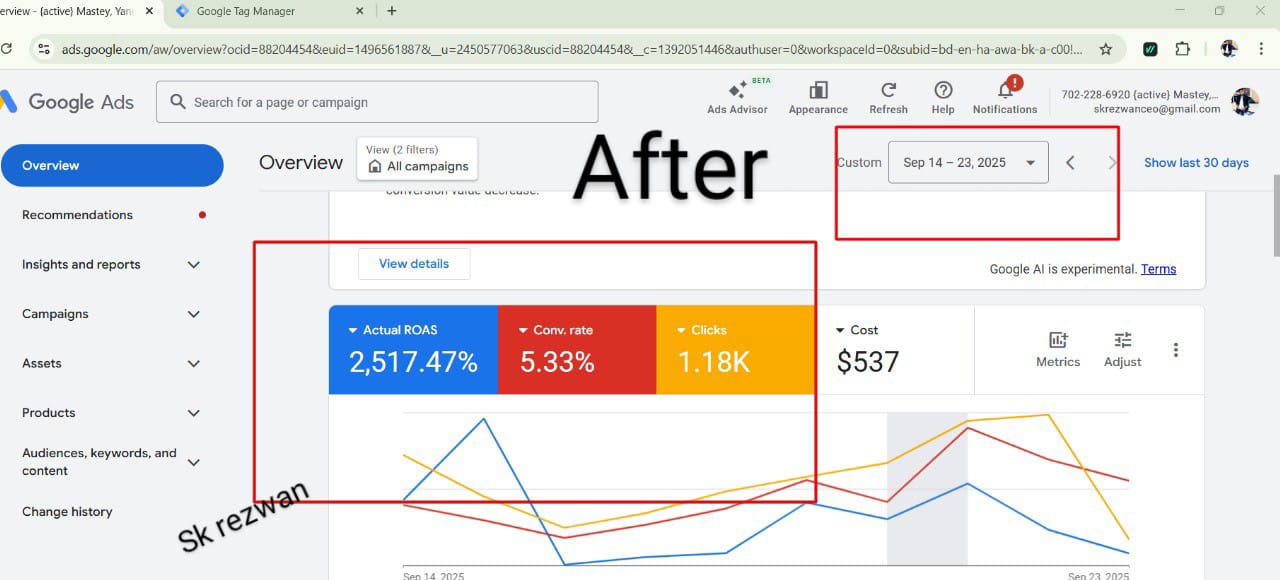
"The results after optimization (September 14–23, 2025) were significant. ROAS improved from 1,711.90% to 2,517.47% — a 47%+ increase. Conversion rate rose from 4.50% to 5.33% — an 18.4% improvement. Cost dropped from $1,250 to $537 — a 57%+ reduction. Clicks went from 2,020 to 1,180, intentionally narrowed to eliminate low-quality traffic."